Friday, February 08, 2008

Int'l Conference of the Society for Women and AIDS in Africa


In 2007, 1.6 million African adults and children died of AIDS, 1.7 million African adults and children were newly infected with HIV, and a total of 22.5 million Africans were reported as living with HIV.

12 million African children have been orphaned by AIDS since 1981.

Source: UNAIDS


Hello! As a member of PC Burkina's HIV/AIDS Task Force, I had the opportunity to participate in the 11th Int'l Conference of the Society For Women and AIDS in Africa/Association des Femmes Africaines Face Au Sida from February 4th to the 7th. Below is an article I wrote on the conference for the Zakramba, PC Burkina's monthly volunteer newsletter. It was a great experience and an informative and generally encouraging look into development both at and beyond the grassroots level. The conference consisted of SWAA/AFAFSI delegations from countries across the continent and representatives from a host of int'l organizations and NGOs.

News from the A-Team:

11th International Conference of the Society for Women and AIDS in Africa

by ATF member Chrissy Hart, GEE

February saw the descent of a particularly impressive and mobilized group of individuals upon Ouagadougou. The 11th International Conference of the Society for Women and AIDS in Africa convened on February 4th and consisted of a variety of lectures and round table discussions on themes including: epidemiology, prevention and public health, clinical care, gender and HIV/AIDS, stigmatization and discrimination facing people living with HIV, economic and socio-cultural issues, as well as politics, ethnicity and human rights. Conference participants included an array of stakeholders: SWAA delegations from countries spanning the continent, health care professionals, NGO workers, government representatives, United Nations and World Health Organization officials, and us, Peace Corps Burkina’s AIDS Task Force. The conference was sponsored by UNAIDS, Unicef, and PAMAC (Programme d’Appui au Monde Associatif & Communitaire de Lutte Contre le VIH/SIDA) and the theme was “HIV/AIDS, Gender, and Human Rights: It is time to act.”

The Society for Woman and AIDS in Africa was born when several key African women leaders predicted that HIV/AIDS would most severely impact African women and children at the 1998 4th International AIDS Conference in Stockholm, Sweden. Today, SWAA consists of a network of 41 country offices and is the only pan-African HIV/AIDS organization working with and for women and their families based on locally determined needs and priorities. SWAA’s mission is to advocate on behalf of women, children and families in the fight against HIV/AIDS and to mobilize communities by strengthening capacity to prevent, control, and mitigate the impact of the epidemic. The international organization envisions a world free of HIV/AIDS where African women and children are empowered to claim equal rights, access to health care, education, and economic and socio-cultural opportunities.

Dr. Claude Millogo, PC Burkina’s Health APCD, is the President of SWAA Burkina and was one of the principal coordinators of this year’s international conference. The quality and professionalism of this year’s conference certainly made an impression on participants based on numerous comments made during the closing ceremonies, much to Dr. Claude’s credit. Members of the AIDS Task Force assisted in an organizational capacity and with translation for Anglophone participants and were able to attend a number of lectures and round table discussions.

Highlights of the conference included a lecture on various efforts toward universal access to HIV/AIDS prevention, care and treatment, a round table discussion on working with HIV+ youth and another on methods of prevention such as the female condom, microbicides, and male circumcision. Robbie Nelson (RPCV-Tanzania), a representative of The Female Health Company – the sole manufacturer of the female condom - presented on the development of the first and second generation female condoms and fielded a host of questions pertaining to marketing, use and accessibility. Another interesting presentation was put on by The Condom Project, a U.S.-based non-profit organization sponsored by the United Nations and Mtv. The presentation included a video documenting the successes and failures of promotion and training on use of the female condom among sex workers in Ethiopia. Perhaps most engaging was a presentation by a member of SWAA Ghana on the comprehensive educational campaign that they’ve undertaken to create awareness of and promote the female condom throughout the country. The scope and success of their efforts, from trainings of trainers to a multi-media advertising campaign, was truly impressive. Finally, another exciting aspect of the conference was a reception for participants hosted by Chantal Campaore, the first lady, at the Presidential palace. Attendees enjoyed cocktails and hors d’oeuvres, good music and even got down and danced with Madame La Presidente.

The conference was a unique and illuminating experience for members of the ATF. We helped out a little and had the opportunity to learn and experience a lot. It was encouraging and inspiring to be exposed to such a dynamic group of men and women focused on change and progress in Africa, engaged in candid and frank discussions about reality and how to move forward from the status quo. I wish that every volunteer had the opportunity to participate in something like the SWAA conference and observe a pan-African effort that, though it faces significant obstacles, is making a real impact.

The AIDS Task Force would like to thank Dr. Claude for the opportunity to help with and participate in the 11th International SWAA Conference and to congratulate her for all of her efforts and contributions as SWAA president. Targeting the HIV/AIDS epidemic is one of the most daunting undertakings one can imagine, but committed, mobilized individuals like Dr. Claude and the conference participants engender hope as progress continues.

Wednesday, January 09, 2008

Morocco


First things first. I’m posting two blogs at once so please check out the previous one about my trip home if you haven’t done so already. Also, I’ve changed my procrastinating ways and finally uploaded lots of current pictures on my new Picasa photo-sharing page (they‘re downloadable, for those who make an appearance), so see the sidebar/below for the link and check ‘em out.

http://picasaweb.google.com/Hart.Christine

As I mentioned in my previous blog, fellow volunteer Joel and I made a stopover au Maroc on our way back to the land of sand. We arrived in Casablanca and hopped a train (a train! one that came on time! seriously!) to Fès, one of Morocco’s imperial cities and the hub of Moroccan culture and art (the city was founded by Romans in the 8th century B.C.). After a scenic 5 hour train ride through the Moroccan countryside, we disembarked and took a cab to Fès El-Bali, the medina or old city. Most Moroccan cities have a medina which is the ancient (and typically still current) city-center, made up of a maze-like network of stone streets and alleyways, medeival in feeling but quite modern in function.

We stayed at a modest but centrally-located hotel that a friend had recommended, enjoying the incredible views of the medina from the rooftop terrace. Though it was much colder than we expected (they actually have cold in North Africa), we bundled up and spent two days drinking Moroccan coffee, sampling tagine and other local fare, and trekking through the medina, getting lost and more lost, but always able to recover our orientation thanks to Joel’s actual geographical sensibilities and my bizarre, slightly inconsistent directional sixth sense. We saw Fès’s famous tanneries, the origin of some of the world’s most reputed leather goods, toured a few carpet shops, admired many of the 350 mosques that lie inside the medina, drank delicious mint tea, and chatted up several friendly shop owners, all impressively good-humored and persistent. I did end up buying some gorgeous Fès needlework and a pretty Berber bracelet, but was able to restrain myself for the most part.

The trip was a great transition on our way back to Burkina and la vie africaine. It was neat to see a small slice of North Africa and appreciate some of the cultural variation (not always so obvious here), that makes Africa such a rich and interesting continent. Morocco certainly whet my appetite for my post-service Africa exploration, I can't wait to see more of the continent!

What would happen if one woman told the truth about her life?
The World would split open.


Muriel Rukeyser

Christmas Cookies and Culture Shock

Bonne Année 2008!

I’m back in Burkina after a whirlwind trip home that involved several cities, holidays, a wedding, and much-needed quality time with friends and family. America was great but it’s good to be back here with a new appreciation for the 7 months I have left in Burkina.

I left Burkina in mid-December with several other homeward bound volunteers. After a layover in Casablanca and a day of travel, we arrived at JFK. My initial reaction? First, amazement at the diversity of the people I saw - nationality, skin color (an array beyond black and white, that is), style of dress, etc. Second, the enormity of, well, everything; the buildings, the parking lots, the roads, the crowds of people, the selection of items at the airport shops…it was at once slightly overwhelming and wonderfully familiar to be plunked down in the land of consumerism and comfort.

I grabbed dinner with a volunteer I’d traveled with and a Peace Corps friend who came to meet us at the airport, enjoyed my first beer aux Etats-Unis, and embarked on my final flight to Buffalo, eager to see my parents and sleep in my own, miraculously cloud-like (ok, what I’d imagine a cloud would be like) bed.

Home was good - lots of parental TLC, updating my iPod, Mom’s cooking, catching up with high school friends, snow, Christmas at home, seeing family, going to church. It was all easier and more familiar than I thought it would be…until I went shopping the day after Christmas (imagine a foreboding musical interlude here). I was scheduled to continue my journey to Annapolis for a wedding three days after Christmas so, armed with gift cards and a serious shopping list of items to bring back to Burkina (a garlic press, trail mix, shampoo not of European origin, etc.), I set out for the chaotic monstrosity that is a suburban strip mall the day after Christmas. The Subaru seemed to drive itself to Target and Borders (old habits die hard, apparently) and I suddenly found myself standing in front of the biggest building I’d seen in a year and a half (ok, not really, but it seemed that way). Target. Everything under the sun…and more. My memory starts to fail me here. I recall a feeling like horizontal vertigo, if that makes any sense, and experiencing a sort of out-of-body, I’m-here-but-not-really-here daze as I wandered through the aisles, seeking kitchen utensils and nylons. The long and short of it - it was a confusing and somewhat frightening experience, though I did emerge with a garlic press, nylons, trail mix and even managed to continue on to Borders for my East Africa guidebook and issues of The Nation and The Economist (yes! print media! IN ENGLISH!). Needless to say, I didn’t attempt the grocery store. That clearly would have been a disaster.

The shopping episode was followed by fervent packing, a manicure and pedicure (manicure # 2 of my life, pedicure # 1 - enjoyable, to say the least, though I apologized profusely for the state of my feet), dinner with summer camp friends (hello, nostalgia!) followed by an actual camp reunion (hello, former campers who are now in COLLEGE!). The 28th, I was off to Annapolis to see one of my best friends get married. Whew.

The wedding was…awesome. Love, the union of two souls, good friends, good food, dancing, hitting the streets (bars) of Annapolis after the reception - who could ask for more? Despite the wedding chaos, I got to catch up with two of my oldest friends (the bride and bridesmaid), who are both frighteningly adult but comfortingly still very much the girls I started going to camp with in the 6th grade. I gave one of the readings during the service and managed (I think) to speak clearly and slowly and to avoid tripping on the way to or from the podium. Good stuff.

Next, I continued up to Manhattan (the Jersey Turnpike - so familiar in its monotony and occassional stench) to visit college friends and celebrate New Year’s Eve. I enjoyed the excellent hospitality of friends and even a surprise visit from a friend all the way from Chicago. It was so good to fall into old routines, to fill my friends in on some of my Burkina experiences, share photos, and catch up on all the new elements of their lives. Though I definitely felt some disconnect (lack of cultural context, having no clue about movies, new technologies - holy crap, the cell phones! etc.), it was so good to actually be in the presence of the people I’ve been missing for 18 months.

The thing that struck me most about being home, beyond the contrast in quotidian existence - the ease and convenience and richness of American life , was how much more significant the things that are changing in everyone’s lives seem to be. While conversations with high school and college friends revolved around gossip relating to our fellow alums, the news was engagements, marriages, babies, law school acceptances, new jobs, moves to new cities…in other words, the non-trivial, significant, meaningful stuff of life - the lives of twenty-four and twenty-five year olds…adults. And while my life currently exists outside that realm in so many ways, it won’t for long.

After five days in the Big Apple, which included lots of excellent meals (sushi! Mexican! pizza!), and movies, television, the Met, the New York-ness of New York, I headed out to Brooklyn to meet up with Joel, another volunteer, with whom I continued on the Morocco for three days before heading back to the BF (that’ll be another blog altogether). After a brief subway experience and a ride to the airport with a Peace Corps friend, we were off. Back to Africa.


Traveling makes one modest – you see what a tiny place you occupy in the world.

Gustave Flaubert

Monday, December 17, 2007

Homeward Bound

The highest function of love is that it makes the loved one a unique and irreplaceable being.


Tom Robbins, "Jitterbug Perfume"


Greetings and pre-holiday salutations!


It's December 17th and in T-37 hours I'll be HOME! Barring any snow-related delays, in a day and a half my feet will be firmly planted on Western New York....snow. After 18 months in Burkina Faso, I am so-beyond-ready-its-beyond-words-to-explain to be home, amongst my family and friends.


"What!? You're LEAVING?"

For the past year and a half, I've collected a lot of names. In village I'm Christine, Christini, Christina, Miss, Madamoiselle, NASARA! ("white person", screamed repeatedly by small children), la blanche, "fo" (you), but for three weeks, I'm going to be Chrissy. I have images of snow covered trees and drinking eggnog in front of the Christmas tree dancing in my head that are so wonderful, if I thought hard enough I could cry (les larmes de joie, bien sur). OK, I actually DID cry when I was in the bush taxi on my way to Ouaga two days ago.


"But you're coming back, right?"

It's impossible to comprehend being so far away from home for so long unless you've done it. And if you've done it, you know exactly what I mean. I'm glad that I'll probably never go this long without seeing family and friends again. It's certainly caused me to reach deep down into the depths of my strength and fortitude, and has no doubt made me a lot more self-assured, confident, and, well, tough. But, in a nutshell, it's been hard as hell. When I get back to Burkina, I'll have less than 7 months of service left, which will no doubt fly by. It was such a great feeling to leave village, America-bound, but a tad bit bittersweet knowing that soon enough I'll be leaving for good. Literally ever person I came across during my last few days in village told me "il faut saluer les parents et la famille" (to greet my parents and family) or "donnez nos salutations aux gens de l'Amerique" (say hello to the people in America). This experience continues to consist of such an array of ups and downs, despite the fact that I've come so far from the wide-eyed trainee who stepped off the plane into the humid Sahelian night a year and a half ago. I think part of me will stay in Burkina forever. This place is bewitching, simultaneously awful and heartbreakingly beautiful.


My father said that the natural world gave us explanations to compensate for the meanings we could not grasp. The slant of the cold sunlight on a winter pine, the music of water, an oar cutting the lake and the flight of birds, the mountains' nobility, the silence of the silence. We are given life but must accept that it is unattainable and rejoice in what can be held in the eye, the memory, the mind.


Salman Rushdie, "Shalimar the Clown"

Sunday, December 09, 2007

Burkina and Millenium Challenge in the New York Times

U.S. Agency’s Slow Pace Endangers Foreign Aid

By CELIA W. DUGGER

Published: December 7, 2007

The Millennium Challenge Corporation, a federal agency set up almost four years ago to reinvent foreign aid, has taken far longer to help poor, well-governed countries than its supporters expected or its critics say is reasonable.

The agency, a rare Bush administration proposal to be enacted with bipartisan support, has spent only $155 million of the $4.8 billion it has approved for ambitious projects in 15 countries in Africa, Central America and other regions.

And the agency’s slow pace is making it politically vulnerable at budget crunch time. Both the House and the Senate have slashed the Bush administration’s 2008 budget request for the agency, but the Senate has gone a step further, pushing for a change that African leaders say threatens the essence of the agency’s novel approach.

Eyeing the unspent billions, the Senate has proposed that Congress provide no more than half the money up front for future five-year projects, which typically come with a price tag of $250 million to $700 million. Such projects are now fully financed at the start to make sure countries have the wherewithal to finish what they start.

Senator Patrick J. Leahy, the Vermont Democrat who heads the Senate appropriations subcommittee on foreign aid, said that Congress could be counted on to come up with the rest of the money if the countries fulfilled their end of the bargain. But, he asked, where else should Congress look for savings in its foreign aid budget?

“Do we cut maternal health?” he asked. “AIDS? Malaria? Do we cut refugees? The only thing that’s got a blank check is the war in Iraq.”

Agency officials and the African leaders they assist said in recent interviews that the change would be a big step backward. American foreign aid often takes the form of modest, short-term projects that are planned in Washington and carried out by American contractors and charities. But under the agency’s approach, poor countries with sound economic policies and strong track records of helping their people are chosen to conceive and carry out big undertakings themselves.

The Millennium Challenge Corporation’s budget now makes up less than 10 percent of the United States foreign aid budget.

By changing how its projects are financed, “then M.C.C. becomes like the World Bank and all the other countries using overseas development aid in stop and go fashion,” said John A. Kufuor, the president of Ghana, who heads the African Union. “The aid is spread so thin that at the end of the day the necessary difference is not made.”

The Millennium Challenge Corporation’s chief problem has been its sluggish record in getting projects beyond the planning stage to the point where contractors can actually build the roads, irrigation canals, power plants and clean water systems that poor countries say they need.

Sheila Herrling, who follows the agency at the Center for Global Development, a nonprofit research group in Washington, says there are understandable reasons projects take time and suggests that the agency’s current five-year timeline for each one may be too short.

Poor countries, even relatively well-run ones, are not used to planning such complex developments and have needed more time than expected to get them off the ground, she said.

Also, the infrastructure projects poor countries need are prone to corruption, and putting stringent accountability systems in place has consumed more time than expected.

Development analysts have praised the agency for giving poor countries an incentive to make significant reforms to qualify for its big contracts, including improving education for girls, making it easier for individuals to operate on-the-books businesses.

But the agency itself must also shoulder some of the blame for the slow progress, Ms. Herrling said. Its decision-making has been too focused on putting together the projects, rather than on carrying them out.

“It shouldn’t have taken so long,” she said. “The agency needs to figure it out this year. They are part of the problem.”

John J. Danilovich, the businessman and former ambassador who has led the agency for two years, recently reorganized it to concentrate on results with what he called “laser focus.”

“We need to do better and we will do better,” he said in an interview.

Mr. Danilovich, a Bush appointee, has convinced Representative Nita Lowey, the New York Democrat who heads the House appropriations subcommittee that oversees foreign aid, that he is serious. Mrs. Lowey said in an interview that the agency was still unproven. And she was disappointed on a visit to Ghana this year to find that its $547 million compact to develop a modern agricultural economy still was not very far along. But on the need for progress, she said, “I do believe that Danilovich gets it.”

One of many schools in Burkina Faso that had been paid for by a $13 million grant by the Millennium Challenge Corporation.

The future of the Millennium Challenge Corporation is one of the many issues caught in the budgetary stalemate between the administration and Congress.

The administration asked for $3 billion for the agency. In their foreign aid appropriations bills, the House provided $1.8 billion, the Senate $1.2 billion. Mrs. Lowey said she strongly opposed the Senate’s proposal to provide no more than half the financing up front, an idea originally suggested by Senator Richard G. Lugar, Republican of Indiana. The House and Senate are expected to settle the issue by next week.

If the agency gets the lesser Senate amount, under the current rules requiring the money up front, Burkina Faso, a West African country that has spent more than two years qualifying for and drafting its $560 million to $620 million plan, will get nothing, agency officials said. Tanzania and Namibia are ahead of it in line.

Burkina Faso’s prime minister, Tertius Zongo, said his country would be deeply disappointed if the money was not available.

“We have done our part,” he said. “This is a partnership.”

Burkina Faso has gone to great lengths to meet the agency’s good governance standards. The agency gave it a $13 million grant to improve girls’ education, which the country used to build, among other things, schools with day care centers so school-age girls do not have to stay home to look after their younger siblings.

Identified by the International Finance Corporation as one of the most difficult places in the world to do business, Burkina Faso has also halved the number of days it takes to start a business, and reduced by a third the cost of registering property.

In small, poor countries like Burkina Faso, every burp and hiccup of an aid agency like the Millennium Challenge Corporation is news — and often front page news. David Weld, the agency’s country director for Burkina Faso, said he did not know how he could face people there if Congress did not come through with enough money to help them.

“What type of message does that send to Burkina Faso, a country that has spent a huge amount of political capital and money on this process?” he asked. “What does that tell the Togos, the Nigers that want to become eligible? It tells them: Do everything like Burkina Faso, make all these reforms, spend millions of your own money, and then maybe at the end we might be able to sign a compact with you — or maybe not.”


(Posting this surely violates some copyright regulation, please don't report me to the FCC!)


Africans, less esteemed than ever, seemed to me the most lied-to people on earth - manipulated by their governments, burned by foreign experts, befooled by charities, and cheated at every turn.

Paul Theroux, "Dark Star Safari"


Friday, December 07, 2007

World AIDS Day

Large-leaved and many-footed shadowing,
What god rules over Africa, what shape,
What avuncular cloud-man beamier than spears?

Wallace Stevens, "The Greenest Continent"

Greetings!

Thought I'd post a few pictures of our December 1st World AIDS Day event which I organized in conjunction with Diabo's lycée (high school). We started the day off with a foot race followed by a sensibilisation (educational lecture) on HIV/AIDS facilitated by two representatives from Action Sociale, a Burkinabé organization that targets a myriad of social issues and, finally, a soccer match at the lycée between teams of 1st cycle (Sixieme - Troisieme) and 2nd cycle (Second and Premier) students, with a few teachers playing on either team.

The organization of the day's events was a lengthy process but it all went off without many problems, much to my relief. The only letdown of the day was when the mayor of Diabo stopped in halfway through the sensibilisattion, interrupting the speakers to utter a few platitudes, thereby giving a number of students the opportunity to duck out, much to my chagrin. The interruption was so indicative of the excessive and often blind reverance of people in positions of power that pervades Burkinabé society, quite contrary to my democratic sensibilities. The mayor didn't even speak himself but had one of his assistants make a short, dull speech. One of the most significant lessons I've learned here is to be moderate in my expectations so despite the exodus of students, I was still happy that everything went fairly smoothly.


A few pictures of the days events...


Students lined up for the footrace.


And they're off!


On the road...


Messrs. Lompo, Pacmagda and Coulibaly (administrator and teachers)


HIV/AIDS sensibilisation at the Maison des Jeunes
(we had about 400 students in attendance!)


Monsieur Birba, one of the facilitators
(using a megaphone as a microphone)


L'Equipe Rouge


L'Equipe Blanc


Action shot


Medical and teaching skills were not lacking in Africa, even in distressed countries...but the will to use them was often nonexistent. The question was, should outsiders go on doing jobs and taking risks that Africans refused?

Paul Theroux, "Dark Star Safari"

Friday, November 23, 2007

Turkey Day in the Sindou Peaks

A Belated Happy Thanksgiving!

I hope you all revelled in turkey, mashed potatoes, cranberries and other Thanksgiving delicacies and gave appropriate thanks for all of life's gifts and abundances (especially mashed potatoes).

I headed down to the southwest of Burkina Faso - practically a different country being greener and topographically more diverse than other regions (it's a big deal to see a hill in Burkina). After a 14 hour bus ride from Fada, I arrived in Banfora, a city in the very sw corner of BF popular with tourists for its waterfalls and proximity to the Sindou peaks, where I spent the night before heading to the peaks with a big group of volunteers. Some of the SW volunteers had organized an excellent TDay dinner complete with turkey, mashed potatoes, salad and even stuffing, courtesy of a care package. After traversing a bumpy and slightly perilous 67km route (which took about two hours), we disembarked and trekked up to a plateau amidst the peaks where we made camp (set our stuff down) before heading off to climb around the peaks and check out the amazing vistas of the surrounding bush afforded from such heights. We were sooned joined by another group of volunteers and commenced to make merry, give thanks in turn, and enjoy our excellent meal to the percussive stylings of a balafon group (W. African xylophone) under a nearly full moon. We were joined by lots of locals from the nearby village of Sindou who literally danced circles around us. Personally, I exercised muscles that have been long out of use and felt it keenly for the next few days. All in all, it was a unique and enjoyable Thanksgiving celebration in the company of good friends.

After our adventures in Sindou, I stuck around Banfora for a few days with my good friend and travel buddy, Beth. We recovered from the two hours of sleep we'd gotten in the peaks, then explored Banfora a bit before heading 15k outside the city to check out the falls the evening before our departure. We got a ride with a Burkinabé friend who works for Celtel, a cellular service provider, in his spiffy red and yellow Celtel pickup. We had originally planned to bike but were still sore after all that dancing on Thanksgiving so we opted for the vehicular mode of transport. Banfora falls are not particularly grand relative to other more noteworthy falls (Niagara, Victoria and the like) but were a site for sore eyes habituated to the flat savannah of the east.

A few pictures of the peaks, falls and our Thanksgiving fête...


Welcome to the Sindou Peaks!


Peak-turesque

(I am so my father's daughter)


Trekking.


Hiking up to the plateau.


View from the plateau.

Beth and I.

Checking out the views.


View toward the north.


Heather, at an excellent vantage point.

View of the bush beyond the peaks.


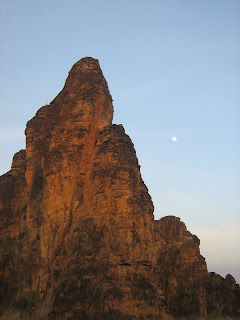
A peak and nearly full moon.


Post-meal repose.


Balafons.

(Yes, they're ALL smoking...gives new meaning to multi-tasking.)


Banfora Falls.


Rapidly moving water = really exciting.


View from the top of the falls.


Me, contemplating profound existential things next to the falls.