Wednesday, February 28, 2007

Pictures from Village

“I know that my achievement is quite ordinary. I am not the only man to seek his fortune far from home, and certainly I am not the first. Still, there are times I am bewildered by each mile I have traveled, each meal I have eaten, each person I have known, each room in which I have slept. As ordinary as it all appears, there are times when it is beyond my imagination.”

- Jhumpa Lahiri, “Interpreter of Maladies”


The mosque in my village.


A courtyard near the mosque.


The mosque.


My friend, Eloi, storing straw to be used as cattle feed during the dry season.


Philomene the coiffeuse (Eloi's wife) - tressing hair.


Gladys, one of their daughters.


Diane, another daughter.


Richard, their son, waiting impatiently as dad makes tea.


Mes petits voisins at the robinet near my courtyard.


Visiting neighbors: Jamila, Latifa, and Yasmina


At the baptism of baby Zouweratu - with mom.


Me and Zouweratu (she's a week old here).


Salimata and Zouweratu.


"What's the rush? Dip your brush into this twilight..."


A women's association in village, dying traditional pagnes (fabric) to be sold to benefit their work.

Laying pagne out to dry.

Salimata and Nancy, my nearest PCV neighbor

Boys playing foosball "baby foot" at the market


Ecole 'B': the primary school where I work.


The kiddies.


“But troubled as these early years of nationhood have been, Africa need not dwell forever in the uncertain twilight zone. Its dreams have only been mislaid, not lost.
- David Lamb, “The Africans”

Monday, February 12, 2007

"I know we've come a long way, we're changing day to day..."


Bonsoir!

(Yes, the title of this entry is from a Cat Stevens song and yes, I think that is totally appropriate given that I am a Peace Corps volunteer).

I'm back in Fada and headed to village tomorrow after a week of traveling for our In-Service Training (IST). The In-Service took place in Ouahigouya, the city where we had our three month training upon arriving in Burkina. For those of you've who've been reading since the beginning, you'll recall that our Girls' Education and Empowerment group lived in four small villages outside of Ouahigouya, where we had most of our classes, biking into the city (realize that the term city is totally relative) a few times a week for training sessions. Our stage (training group) also consisted of Secondary Ed volunteers (high school teachers) who lived in the city proper (and enjoyed such luxuries as electricity and refrigeration...WEAK). Anyway, IST was only GEE volunteers, though we did get to see a few SE volunteers who teach in Ouahigouya. It was the first time our whole GEE group has been together since swear-in, a whopping five months ago. IST is supposed to take place three months into service, after the completion of our etude de mileu (comprehensive village study, basically). It didn't because a new group of volunteers immediately followed ours, which is unusual as they're typically spaced apart by at least a few months. I guess we can thank Mr. Bush for that, since he boldly issued a challenge in the 2006 State of the Union to significantly increase the number of Peace Corps volunteers abroad while Congress chose to maintain our paltry annual budget - democracy at it's best.

It was neat to be back in Ouahigouya, no longer wide-eyed newbies but now significantly more equipped (and slightly jaded) veterans. Our four-day training consisted of sessions on primary project design and management, secondary projects, analysis of our village studies and experiences and activities thus far, as well as a host of other useful stuff. We all took a short Myers - Briggs personality test and I am pleased to report that I have a personality and it is INTP (Introverted, Intuitive, Thinking, Perceiver). From what I gather, we're a pretty interesting bunch (including the likes of Albert Einstein and Marie Curie)...

"They have a finely nuanced ability to analyse situations, find root causes and foresee consequences. They distrust action taken too quickly without the necessary investigation. They are usually levelheaded, objective, impersonal yet intensely involved in problem solving. They are fiercely independent, seeking input and comments from a chosen few. When reporting to others, they need to establish credibility first: their own and that of the person they are reporting to. If the gap in knowledge and expertise is too great and their own proficiency dismissed, belittled or ignored, they will lose interest and motivation.

They are less interested in running the world as they are in understanding it. They are curious and capable of explaining complex political, economic or technological problems, taking great pleasure in explaining all the factors and intricacies. They are rigorous with their thoughts and analysis, choosing the exact words that convey precisely what is meant. They may spend a lot of time defining words, concepts and systems in order to define a problematic solution.

They are armchair detectives, scientists and philosophers, spending most of their time in quiet reflection to ponder truth, and solve mysteries. They may tend to neglect social requirements and responsibilities, finding many relationships to be too superficial to be of much interest."

...so that's me apparently. Analyzng our personalities was fairly interesting, especially considering how intensely introspective just about every volunteer becomes after a few months in the bush. There's nothing like an intensive, substantive cross-cultural experience to put a person better in tune with themselves and shed some light on behaviors, quirks, idiosyncracies, and the like.

The most valuable part of the IST were the casual conversations, anecdotes and opportunities to discuss our experiences thus far with one another and the other volunteers who helped out with the training. We also had an afternoon free to bike out to our host villages and visit the families that we lived with during our initial training. I biked out to Sananga, my host village, with two other volunteers and we spent a few hours visiting all of our families and catching up on village news. Unfortunately (well, fortunately, really) I didn't get to see my host sisters because they were all in the city at their respective high schools. We did sit and talk for a long while with Harouna, my host father, and it was exciting to be able to converse more fluently in local language with my host mom. Our interaction during stage consisted mostly of lots of smiling and gesturing, so we were both excited to have a substantive conversation. They were definitely thrilled to see us in village and it was nice to come back with better lingual skills and cultural know-how in general.

I did see on of my sisters randomly when I was running one evening after our training sessions. I headed away from centre-ville toward the house of a volunteer who lives in Ouahigouya. As I was running, I noticed a young woman staring at me and, as I got closer, I realized that she looked familiar. We stared at each other for a few seconds before I realized that it was Zaalisa, one of my host sisters. She looked taller and a bit plumper (read: no longer super skinny - all of the kids in village looked healthier since this year's harvest was really good). It was so nice to see her and talk about her classes and the family. Seeing my host family made me miss the small-village experience of stage. Diabo is great, but it doesn't have the same close-knit feeling of Sananga (it's probably 10 times as big).

So IST was good overall; it helped me to clarify some ideas and identify new approaches for project implementation. I'm certainly motivated to get back to village and pursue some new projects and better organize projects that I have started. Our ride back was a bit eventful and constituted my absolute worst transport experience in Burkina thus far. A group of 8 or so of us had taken a bus together from Ouahigouya to Ouagadougou, the capital, where we were all planning to stay for two nights before heading back to village. An hour and a half into the ride, one of the tires on the bus blew out and we veered back and forth on the road (at high speed , because everyone drives like a maniac here) until finally and uneventfully coming to a stop on the side of the road. The tire was changed in shockingly good time (this is Burkina Faso, after all, and things that should take an hour often take four or five) but I could definitely could have done without this particular cultural experience.

We spent an enjoyable two days in Ouaga, eating well and celebrating the birthday of one of our volunteers with a fancy-smancy dinner at this nice restaurant near the Peace Corps hostel (I ate grilled capitaine, garlic shrimp, and sautéed calamari - I had forgotten that food like this EXISTED). I also had the opportunity to hang out with my friend Severin from Diabo, who goes to lycée (high school) in Ouaga. I hadn't seen him since September so we met up up, had a Coke together, and caught up on village news, his classes , etc. This trip has been a nice break-from-village-reality but I'm ready to go back...too many days in the big city (I'm falling behind on my reading)!

I guess that's all the news (that's fit) for now. La vie en Afrique is good (though I am in dire need of a bucket bath after my dusty, sweaty transportexperience). On that note...


"And what was that stench in the cupboard?" asked Jimmy.


"Africa," I said.


- Dea Birkett, "Jella: A Woman at Sea"


Thanks for reading.
- Chrissy


IST Welcome Dinner in Ouahigouya


Peace Corps Dance Par - tay, getting down at a volunteer's house


Joel and I


Saturday, January 27, 2007

Every Day is a Winding Road

Hey, All.

First things first. Regarding the new address (see sidebar): my old Ouaga address will always work (it's the Peace Corps office) so, if you have sent something there, never fear, it will be received. I'm using the new Fada address because it's easier for me to get mail in Fada, as I'm there more often.

I'm in Ouaga this weekend for a meeting of our newly formed PC Burkina AIDS Task Force, having been elected the rep from my sector (Girls' Ed and Empowerment). Basically, we get together to discuss HIV/AIDS sensitization - what volunteers are actually doing and how each sector can incorporate activities into their work. We're also trying to consolidate and streamline the myriad of resources and ever-changing news and information so that volunteers can easily access what they need to initiate effective sensitization campaigns. Good stuff.

I just got back from lunch and satellite TV at the American Embassy. Weird. I haven’t seen U.S. network television in 8 months and I just watched an episode of Extreme Home Makeover. I cried...about five times (the stories are so sad!). It was on the Armed Forces Network and followed Access Hollywood or some comparable gem displaying the gag-worthy excesses of American pop culture. Having not been exposed to that stuff (except for the odd Entertainment or People lying around the PC hostel – c’mon, who doesn’t want to check out this years results for “Sexiest Man Alive”?), it was slightly disgusting to be inundated once again with all of the meaningless, materialistic bullshit that pervades American culture...yes, I know I sound like someone who’s been living in the bush for 8 months, go figure. Don’t get me wrong, I am seriously nostalgic for the Land of the Free, but it’s hard to reconcile a lot of what I’ve known and been surrounded by Stateside to what I’m now experiencing.

On that note, what I’m now experiencing is significantly better than what I was. I’m starting to feel like a competent volunteer and a person capable of doing some meaningful work. The transition back to village after my holiday travels was harder than I thought it would be, despite the fact that I was welcomed back so warmly (they really like me!). I had a tough time getting used to the relative solitude and the lack of stimulus and English speakers that my almost three week vacation provided. However, after getting back into the swing of things, I realized how much progress I have made as far as integrating and forging relationships, particularly those that are significant professionally. All of a sudden, I felt really capable of figuring out what to do and how to do it. Since getting back, I’ve revamped my English club at the high school – now it’s just open to the two oldest grades (the students capable of forming actual phrases in English – beyond “How are you?” and “I am fine.”). Our focus is now going to be topic-based discussion, and the kids are enthusiastic about tackling issues that impact them – forced marriage, poverty, female circumcision, HIV/AIDS and the like, which is pretty exciting for me because it makes this endeavor meaningful beyond the English aspect. I’m also hoping that the club will help me identify kids who are interested and motivated in working with me on other projects, namely a peer-mentor program with primary schoolers. I’ve also started a girls’ club with my primary school – the two oldest grades. We’re starting off light – games, songs, stuff like that, but my goal is to start incorporating life skills exercises (we have a really good manual with a ton of activities on everything from values and decision making to pregnancy and forced marriage). Beyond that, I’m working on developing an HIV/AIDS curriculum for my high school, having just recently realized that there is NO HIV sensitization this year (read: no NGOs coming in to do it). Though the principal is certainly motivated, he and the teachers are over-burdened with the overwhelming class sizes and course load as is, so he was excited that I’m up for the task. I’m either going to do it all myself with each grade level or try to make it a peer education project. Lastly, I’ve started devoting each Tuesday to helping our with baby weighing and vaccinations at my village’s clinic. There are 2.5 babies born every day in the department, which is the administrative equivalent of a county but really the size of a few small towns in the U.S. (total population is 22,000+). I help with the record keeping, which is basic but time consuming, and get to hang out with lots of cute kids in the meantime. So that’s my update, work-wise. Things are definitely just getting off the ground but I am beyond thrilled to be occupied every day.

Next week we (all the Girls' Ed volunteers) head up to Ouahigouya, where we had our three month training, for our In-Service Training (it's usually supposed to take place three months into site, but for us it'll be at five because another incoming group's training occupied the time when we should have had it). It's our opportunity to discuss our experiences, observations and challenges thus far and receive training or consul based on our needs at this point. It's also the first time our group will all be together since swear-in, so it'll be great to catch up with everyone. I'm going to try to visit my host family as well.

Regarding goings-on in village, I experienced a rather startling realization about two weeks ago. The existence of excision (female circumcision) was certainly something I was aware of and something that we touched on briefly during training, but the reality of excision in village only really became apparent to me recently. I had been in Fada for my birthday and had stopped at the internet cafe before hopping on the bush taxi to travel the 60k back to village. While I was using the computer, this sort of jolly, bumbling older man walks in and, being a nassara (white), I glance his way but don't give him to much thought. I get back to village and am biking down the main road to the market and I notice that there's a meeting going on at the maison des jeunes (big building that hosts lots of different activities). I notice a nassara outside which is a bit curious but continue on to the marche for veggie-shopping and socializing. As I'm biking back, a younger guy stops and greets me so I stop pedaling and talk with him for a few minutes. Turns out he's from Tibga, a village about 25k from Diabo where there's another volunteer. He then explains to me that he works with the Catholic mission there and they're doing a sensitization on excision for opinion leaders in the community (so the white guy's a French priest, that makes sense). I think "hey, that's cool" and ask him if they'll be back. They will, so he tells me to follow him over to the meeting, where the discussion portion of the sensitization is going on, so that he can grab the schedule to let me know the date. I walk up to the door as the chef from a neighboring village is coming out (this dude is COOL, I visit with him from time to time because my friend is his daughter-in-law - he's this tiny little man who always wears a striped bou-bou and a kind of bowler-type hat, very 1900). We chat and then the young man indicates that I should come inside to meet the priest.

He's sitting in the back of the room, behind the audience, listening to the discussion. We exchange greetings and head outside to talk, at the same time I realize he's the nassara I'd seen at the internet cafe that morning. He introduces himself, tells me he's the priest at the Tibga mission and that he used to be at the mission in my village (our current priest is quite boring). He turns out to be this really dynamic, energetic guy and we start talking about excision, which, it turns out, is still practiced by the majority of the population, we're talking like 80% of girls, AT LEAST. This is rather shocking news to me, but it turns out that excision is a pretty hush hush deal so it makes sense that I haven't been aware of it. It is technically against Burkinabe law, but prosecutions are few (though apparently there has been one prosecution of a vielle (old lady) in a nearby village).

The really sad thing, beyond the totally grotesque, reprehensible act of cutting off a young girl's clitoris, is that it's WOMEN who promote and perform this heinous act. WOMEN mutilating other women. Let's start with the 3 months a girl spends sitting on a pile of sand (and NOT going to school) because she's in too much pain to move and continue with the potential for infection, increased risk of STDs (a 400% higher risk of HIV infection) and potentially fatal complications during childbirth. On top of this, she will experience a great deal of pain during intercouse and will most definitely never enjoy it. I had a conversation with some of the male clinic staff over tea and the graphic descriptions of problems arising from excision during childbirth made me thankful that my French level only allowed me to understand 2/3 of it.

There are people, namely younger parents, who understand that excision is a bad thing, but often the authority of older members of a family trumps a parent's opinion or wishes, so the excision occurs anyway. This is fueled by the plethora of myths that girls won't be able to procreate without being excised, will be undesirable to men, and the like.

Though I have some very strong feelings, naturally, on the matter, I'm going to let this subject lie as the Tibga mission is doing a great job of making an effort to sensitize people to the many, many risks of female circumcision. Beyond that, their moral authority is more effective than my plain old nassara-ness will ever be, not to mention that taking this issue on could kill my stellar popularity ratings au village, risking the success of other projects. I will, however, be present at the next sensitisation and have already conversed with some younger women, whose progressive views on the topic I pretty much (correctly) assumed. There are a lot of elements of culture in Burkina that I disagree with but can rationalize to a degree or accept based on circumstantial factors, but the prevalence of female circumcision in Burkina (one of the highest in Africa) is really revolting and has certainly cast a dark shadow on la vie simple au village.

OK, on that cheery note I'm going to beg off in the interest of getting some actual work done here in Ouaga. So, 'til next time...

"We are the ones who first ploughed the earth when Modise (God) made it. We were the ones who made the food. We are the ones who look after the men when they are little boys, when they are young men, and when they are old and about to die. We are always there. But we are just women, and nobody sees us. "

- Setswana poem, Botswana -

Thanks for reading.

Chrissy

http://www.stopexcision.net/

http://en.wikipedia.org/wiki/Female_genital_cutting

Tuesday, January 16, 2007

NEW ADDRESS!

Hey, All.

This is my first posting as a 24-year old, exciting stuff (thanks for all the birthday greetings, messages, e-cards, etc). I am certainly older, wiser (debatable), and more fully situated in the realm of adulthood - frightening. Had a wonderful weekend here in Fada with a bunch of other volunteers. We ate, we drank, we made merry and welcomed my 24th year in an altogether enjoyable fashion. Aside from the fete, I managed to finish my 'etude de milieu' (big old report summing up all that I've seen and learned in the last few months) so I'm still productive in my old age (though my English and spelling are in a sorry state).

Anyhow, not much to report having been back in village for just a week and a half, so I'll save my energies for the next blog entry. I do, however have a NEW ADDRESS, right here in Fada, which will make receiving of mail a whole heck-of-a-lot easier, since I'm here fairly often and not in Ouaga all that much.

So:

Christine Hart
BP 228
Fada N'Gourma
Burkina Faso
West Africa

There you have it. Thanks for reading, I'll find some interesting things to report next time. Did I mention that I've eaten grilled caterpillars? I did. They taste like...grilled caterpillars.

Best,

Chrissy

Friday, December 29, 2006

Ghana and Cote d'Ivoire: A Photographic Summary

After an altogether fantastic two weeks in Ghana and Cote d'Ivoire (and a 17 hour bus ride) I am back in Burkina. Since I have lots to share and tell and a picture is worth a thousand words, here are some pictures (and some words) to give you a taste of my travels to foreign lands...


Beth and I at the Burkina/Ghana border, donning our Peace Corps wear. Our trip to Accra took about 23 hours. We left at 8:30 am, arriving the next day around 7:00 am. Despite the length of the trip, it was more comfortable than many transport experiences I've had in Burkina thanks to air conditioning and relatively comfy seats - luxury takes on a whole new meaning in West Africa!
We arrived at Chez Lea in Accra and were spoiled during our stay with movies, many many episodes of Desperate Housewives, amazing Indian food each night, comfy beds, air conditioning and the excellent hospitality of our hostesses, Lea and Simran.

Lea, Beth and I. Out for a taste of the Accra nightlife.

We took a trip to Bojo Beach, where Beth and I revelled in the sight of the ocean, the first major body of water we'd seen after nearly seven months in dry, landlocked Burkina.
Lea, Simran, and I on the beach.
Me - in the O-C-E-A-N!
The beach.

Our transport to the mainland, a traditional boat (I'm fairly sure they're made from palm trunks).


Beth and I took a day trip to Akosombo to see Lake Volta, the world's largest man-made lake, and the Akosombo dam, which provides Ghana and neighboring countries with the majority of their hydroelectric power.


Beth and I standing on the dam. We had an interesting tour, which included our tour guide professing his love for me.


We couldn't take photos of the intake chambers of the dam, but this is the body of the dam and the spillway.


Aylo's Bay, on the Volta River, where we enjoyed a lunch of fried plaintains and a Ghanaian rice dish for lunch.


A suspension bridge on the Volta.


There aren't too many vistas like this in Burkina!


Lea, Simran, Beth, and I on our last night in Accra.


Cote d'Ivoire


We left Accra and took a "sept-place" (seven seat Peugot station wagon) to the Ghana/Cote d'Ivoire border. Customs itself was relatively problem-free, but we were hassled a bit at a few of the four barriers (military police blockades) during the 65k trip to Aboisso, Beth's sister Sarah's village. Sarah works with an NGO initiating and supervising sustainable literacy programs on cocoa and coffee plantations.

Aboisso. On the road to Sarah's house.

Sarah's house in Aboisso, Cote d'Ivoire.


Sarah, her colleague Charlotte, Beth, and I eating Futu, an Ivoirian dish made from manioc and bananas and served with a spicy sauce.


Centre-ville in Aboisso.


One day we took a hike en brousse to a village of Burkinabe who are working on a cocoa plantation where Sarah has a literacy program. It was neat to speak a little Moore and enjoy their hospitality which included some amazing fruit - coconuts, papaya, and pineapple.


One of the many palm grovers sur la route - these trees produce palm oil.
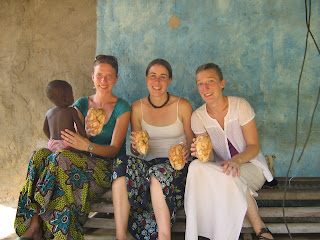

Drinking coconut water.


Beth and I with our new Burkinabe friends.
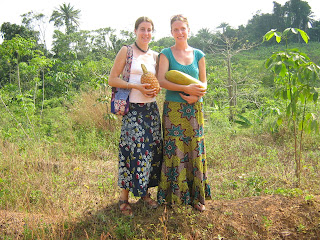

Beth and I on the walk back, displaying our gifts of fruit, including the world's largest papaya.


We also stopped in another village on our walk back where we ate at the chef (chief's) house.


Sarah and Beth with the chef (far right), Sarah's Senegalaise friend, Pap-Jean, and Paul, a Burkinabe literacy teacher.
On Christmas Eve, we travelled to Maffure, a small city about an hour away from Aboisso, where Sarah did some of her training. We enjoyed an amazing dinner of fresh fish and chicken with Kofi, Sarah's tutor. At the end of the meal Kofi told us how much he respected our work in West Africa and, despite our protests that we gain as much if not more than we give, he insisted that we sacrifice quite a lot in coming here, working in small villages, and radically altering our lifestyles. Whether or not I agree with him, it was wonderfully encouraging to hear him express these sentiments and especially poignant of Christmas Eve, when we were all missing family, friends and the festiveness of the holidays at home.


Breakfast on Christmas morning: Beth, Sarah, Pap, and Assi, Sarah's colleague. The bucket in the middle of the table is filled with an enormous amount of fruit salad.


Hanging out on the porch, drinking some Christmas Morning mimosas.


A Christmas visit from the neighbors.
Christmas Dinner.

Beth, truly in the holiday spirit.


Pap and I.

Departure.

A la gare, Aboisso. We took a sept-place to Noe, the town at the Ghana-Ivoirian border, then caugh a six-hour trou-trou (Ghanaian bush taxi) ride to Kumasi, a large city in central Ghana and the heart of Ashantiland. We spent a night at a guesthouse there before, exploring a bit before embarking on our 18-hour bus ride back to Ouaga.


Ghana


The Grand Market in Kumasi, the largest market in West Africa.

Grand Market.

Ghana has an amazing array of fabric, from traditional woven kente cloth to tie-dyed and patterned batik cloth. Beth and I spent our day in Kumasi wandering around centre-ville and the market and buying lots of cloth to have tailored back in Burkina.


Beth at a cloth stall in the market.


Batik cloth.


You don't often see traffic like this in Burkina. One of the biggest differences we noticed between Burkine and Ghana and Cote d'Ivoire was the prevalence of cars. In Burkina, even in the cities, motos and bicycles exponentially outnumber cars.


Well, that's all I've got for now - will try to post more vacation pictures as well as pictures from my village on my Shutterfly site.


Happy Holidays!